 The DD1 wheelbase
Wheelbase — direct drive
20 Nm of direct drive — far more than I need. I bought it for the headroom, not to use it: I run high detail with the torque well under max.
$1,200Check price
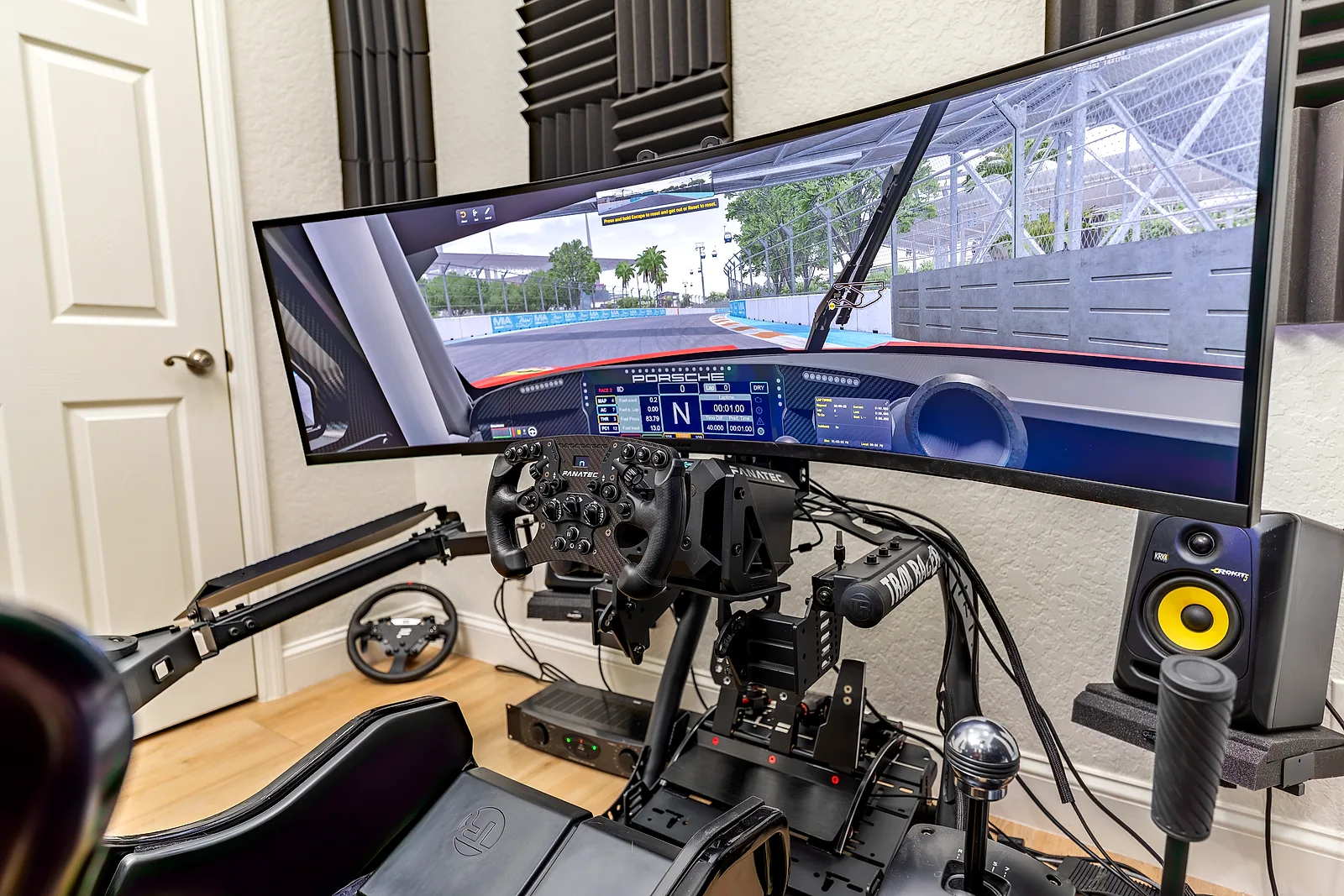
The real Fanatec sim rig I race iRacing on — a Podium DD1 and ClubSport gear on a Trak Racer TR8 Pro, ClubSport V3 pedals tuned to brake by pressure, and a ButtKicker for tactile feel — tucked into a corner of my 10×10 music studio. The gear I own, how I set up force feedback, and why I run one ultrawide instead of triples.
Last updated 2026-06-28

Kyle Romero — I race iRacing exclusively, tune my own force feedback and haptics, and personally own every piece of gear on this page.
The rig
The whole rig lives in one corner of my 10×10 — the same room as my music studio. That dual-purpose reality drives a lot of the choices here, starting with a single ultrawide instead of triples: I just don't have the wall for three monitors.
The frame is a Trak Racer TR8 Pro and it doesn't flex at all under the DD1 — genuinely impressive for the price. If I built it again I'd go full aluminum extrusion for the expandability, and I'd pick a more padded seat: the Trak Racer GT Pro is rock-solid and realistic but firm, with very little cushion for long stints.
Feel
I keep the base settings deliberately simple and do almost all the real tuning per-car inside iRacing — it's far less fiddly than chasing it in the tuning menu.
Set the base
Force feedback maxed, sensitivity and rotation on Auto. The only knob I actually touch is the interpolation filter — I run it around 3, because any lower and the wheel just buzzes.
Tune in-game
Everything else happens in iRacing. Per-car FFB strength in the app keeps it simple and consistent, and that's where the real feel comes from anyway.
Respect the 20 Nm
The DD1 puts out 20 Nm — strong enough to break your thumb if a car snaps the wheel and you're not braced for it. I never run it near max; the headroom is the point, not the daily setting. Overkill, on purpose.
“Force feedback maxed, the rest tuned in-game — simple on purpose.”
The gear
The DD1 wheelbaseWheelbase — direct drive
20 Nm of direct drive — far more than I need. I bought it for the headroom, not to use it: I run high detail with the torque well under max.
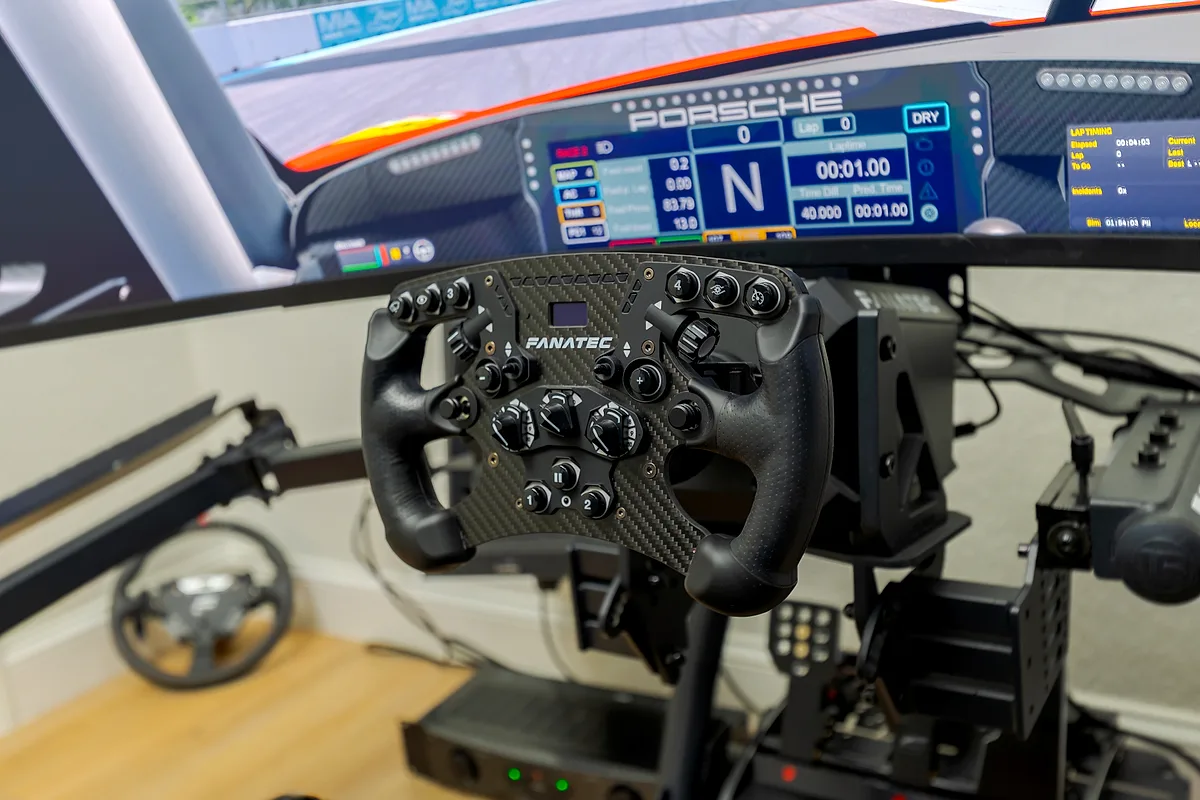
Wheel — formula
Lives on the base most of the time — my daily for sports-car racing and the odd open-wheeler.
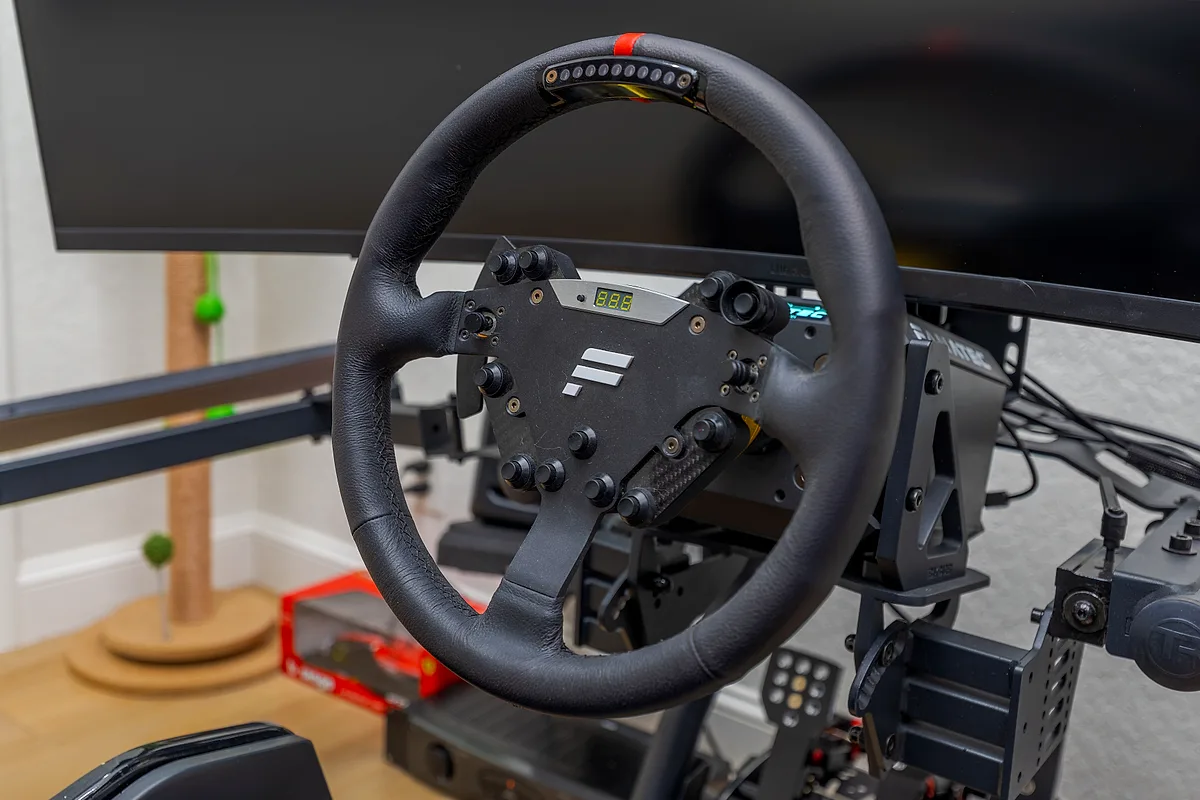
Wheel — round
Swapped on for NASCAR and dirt — a round leather rim just makes sense for ovals.
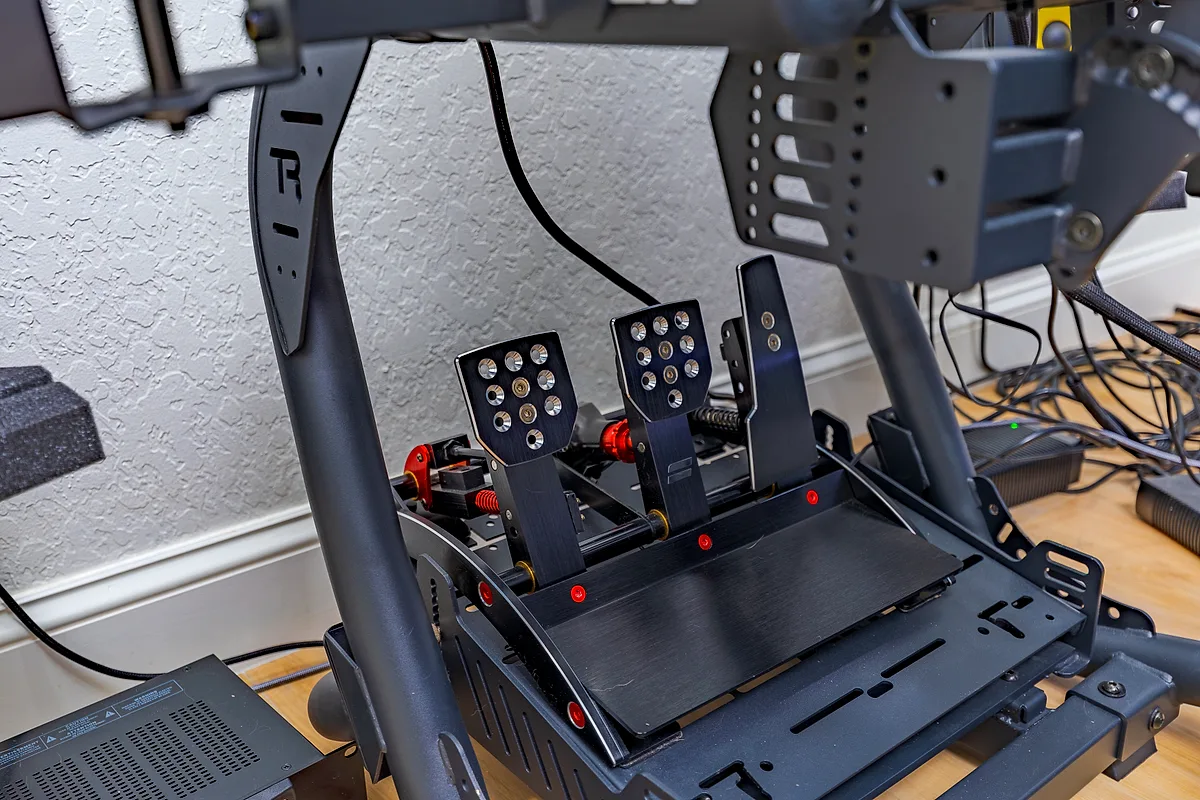
Pedals — load cell
Set super stiff with almost no travel so I brake by pressure, not distance — far more repeatable. The brake performance kit is what takes them from good to great.
 Shifter
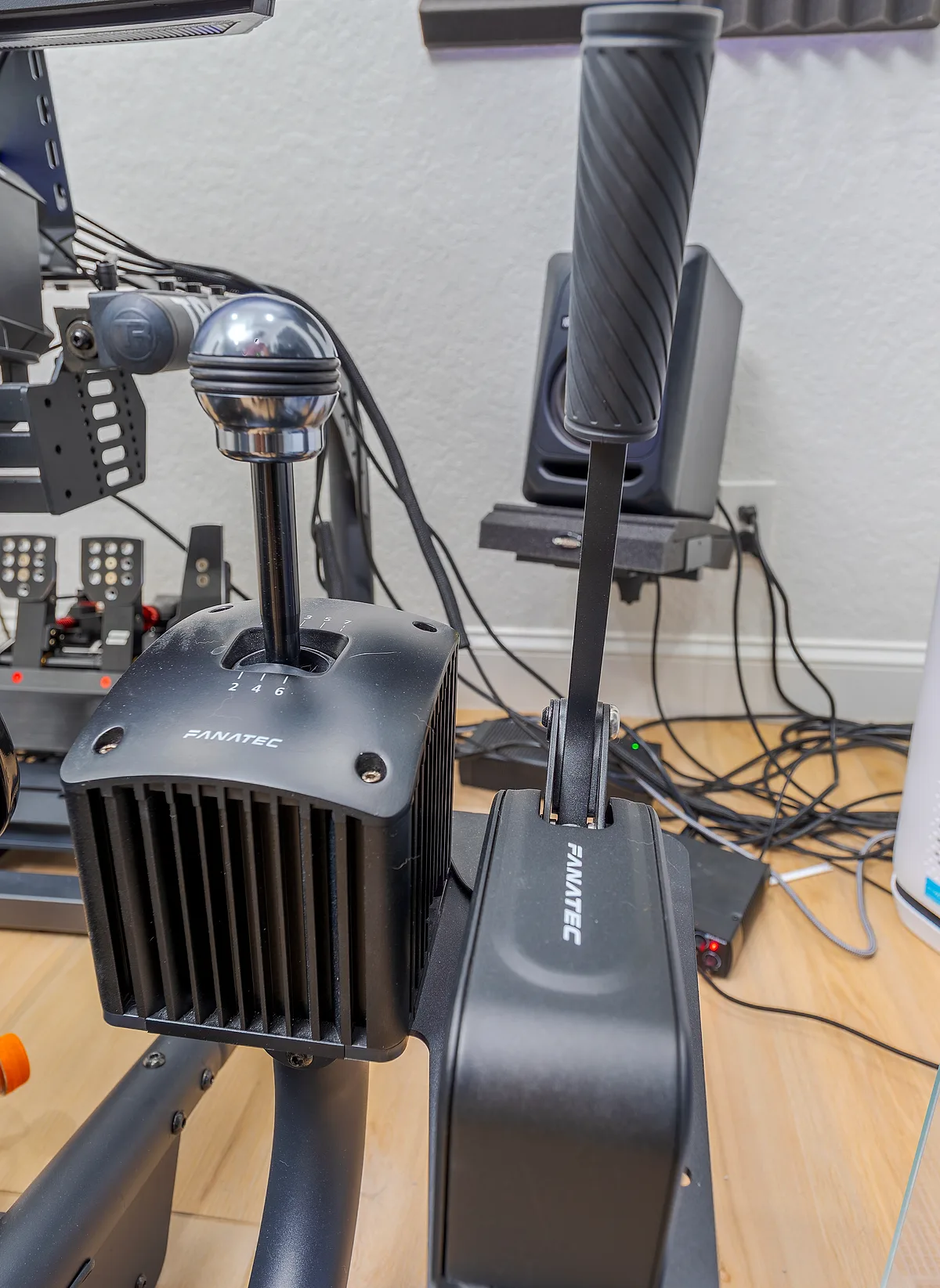
Shifter — H + sequential
H-pattern for older cars, flick to sequential for everything else — one unit covers both.
HandbrakeHandbrake
For rallycross and the occasional handbrake-into-the-pits moment. Not used every session, but I'm glad it's there when it is.
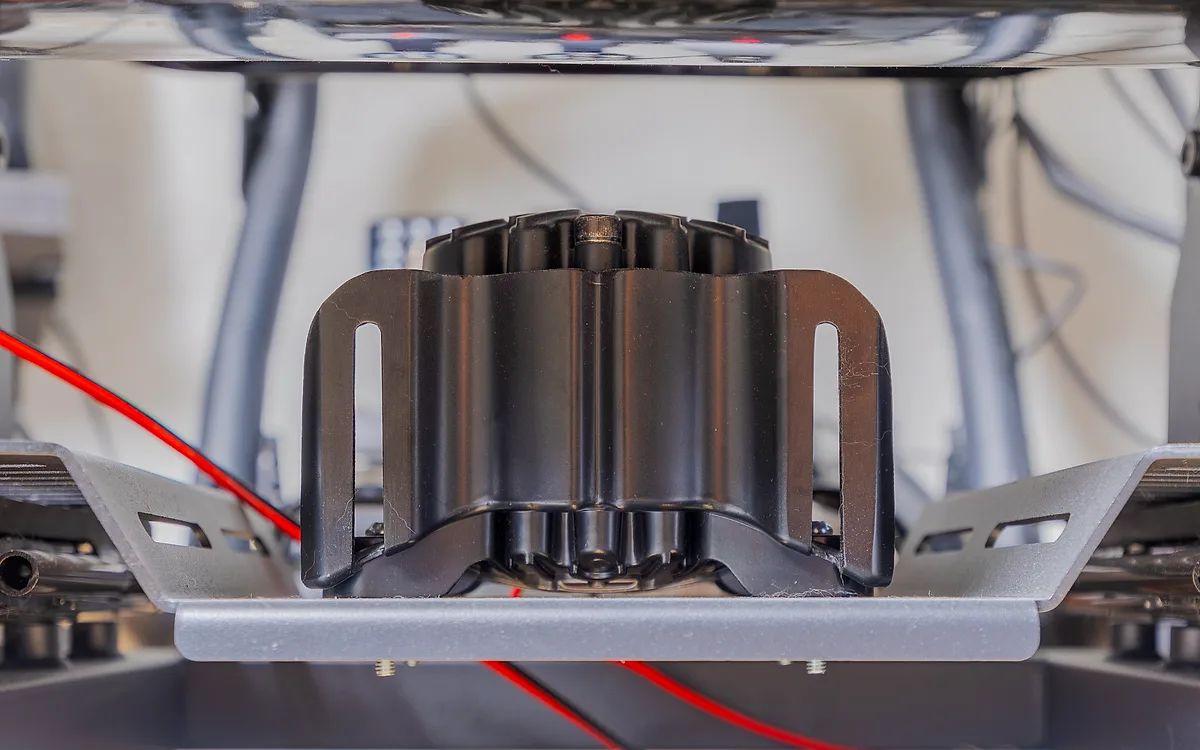
Haptics — bass shaker
Bolted under the seat, driven by the Behringer A800 amp below, and tuned in SimHub. It's how I feel the rear stepping out and the curbs before I see them — I won't build a rig without haptics.
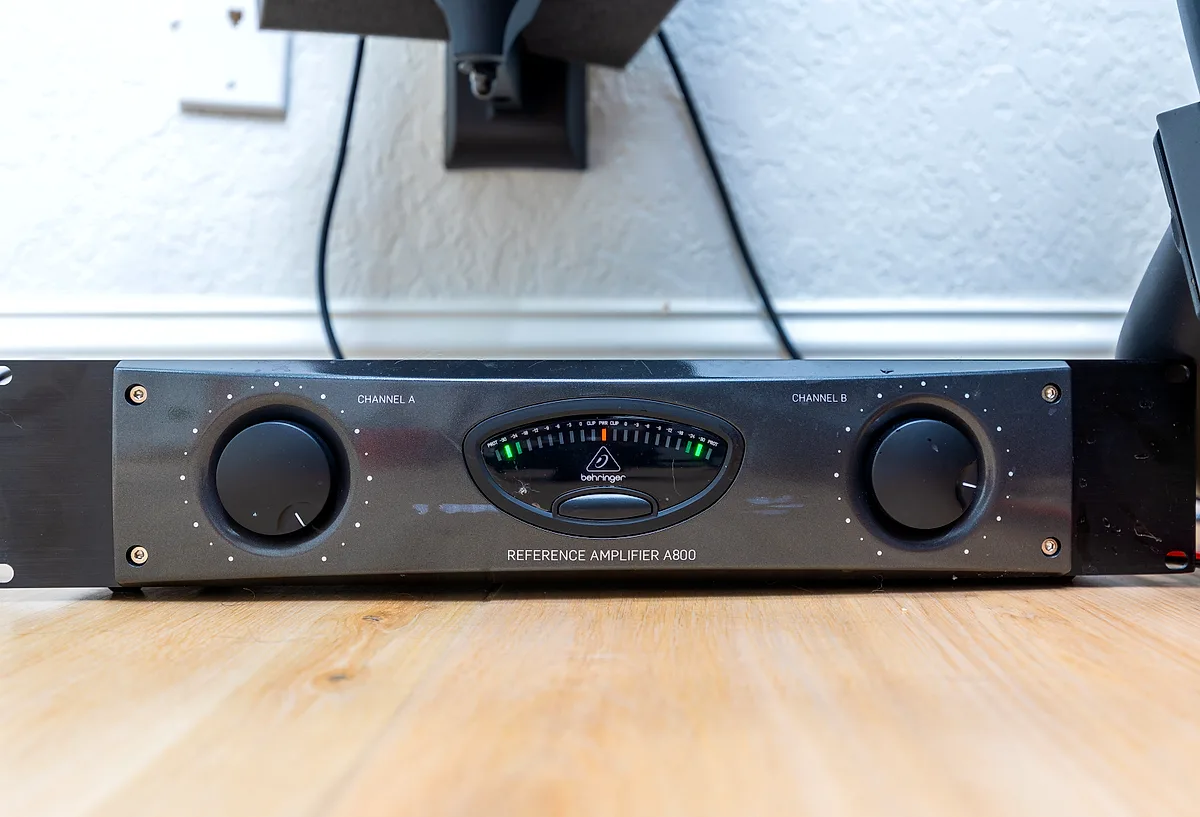
Haptics amp
A studio reference amp (2×400 W) repurposed to drive the ButtKicker — far more power than a shaker needs, so it never strains no matter how hard I push the effect.
The TR8 Pro frameCockpit
Zero flex under the DD1's 20 Nm — I've never felt the frame move. A genuine bargain; for the money it's hard to beat.
The GT Pro seatSeat
Rock-solid and realistic, but honestly very firm with little padding. For long stints I'd pick a seat with more cushion — learn from me.
The 49″ ultrawideDisplay
One 49-inch ultrawide instead of triples — a footprint call, because the rig shares a 10×10 room with my studio. I'd run triples if I had the wall for it.
KRK Rokit 5Sound
Not what I'd buy for the rig today — I just had these from my studio days — but they earn their keep. The upside over a headset is you don't cook yourself; sim racing with stiff pedals and a 20 Nm wheel is a real workout.
Braking
The ClubSport V3s are great load-cell pedals for the money, and the brake performance kit takes them up a level — but the bigger thing is how I set them.
No travel, all pressure
The load cell reads force, not movement — so I run the brake very stiff with almost no travel and modulate on pressure alone. It feels alarming at first and takes a week or two to recalibrate your foot, but it's far more consistent than a soft, long-throw pedal.
Dial it in
They're tunable enough for any feel — stiffer, softer, more or less travel — and I set the brake-force range in iRacing so 100% input lands right at my hardest comfortable press. Worth the time to get right.
“I brake by pressure, not distance — it's just more repeatable.”
The view
I run a single 49-inch LG ultrawide (5120×1440, 240 Hz). It's a footprint call more than a performance one — the rig shares the room, so triples were never on the table. If you have the space, I'd genuinely recommend triples; not being able to see beside you is workable, but less immersive.
VR is the upgrade I want next, but it's waiting on a PC upgrade to drive the pixel and frame demand. I'm eyeing the Pimax Dream Air for the small form factor and OLED — comfort matters a lot when you're in the seat for a couple of hours.
The machine
The same machine that does everything else I do — a gaming-leaning build, so iRacing on a single ultrawide isn't a stretch. VR is where it'll start to feel the limits, which is part of why that upgrade comes first.
On the rig
Three things run alongside iRacing every session — one to tune the feel, one to get faster, one to keep me out of trouble.
The reason I'm here. The fairest, least-spammy online racing, the best physics and sound, and a new graphics engine on the way. Graphics aren't its strong suit yet, but nothing else is close on the racing itself.
Where I tune the ButtKicker per-car and per-surface. Honestly a painful process to dial in — but completely worth it once it's right.
An AI coach I use to find lap time fast — one of the quickest ways I've shaved tenths off.
A smarter spotter than the in-sim one. Knowing exactly where cars are around you is crucial on a single screen, when you can't just glance sideways.
Approach
If there's one thing I'd tell anyone building a rig: don't skip haptics. Tuned right, the ButtKicker disappears — you stop noticing it until you switch it off and the whole thing suddenly feels flat and lifeless. A motion platform like a D-BOX would be the dream, but a well-tuned shaker gets you a surprising amount of the way there.
Two small things that aren't really gear: I wear gloves and grippy pilates socks every session. The gloves are mostly to protect the wheel — these rims aren't cheap and bare hands wear the grip over time — and they help grip too. The socks let me drive without shoes but still keep my feet planted; barefoot on stiff pedals, you slide right off once you start sweating. And you do sweat — which is half the reason I run speakers instead of a headset most of the time.
“Tuned right, the haptics disappear — until you turn them off.”
“20 Nm is overkill on purpose: you want the headroom, not the daily setting.”
A note on trust: owning a product never changes its score here. Rankings are computed deterministically from sourced specs by the same code for every product, and affiliate relationships are walled off from the rankings — some outbound links may be affiliate links, at the same price to you.
FAQ
I keep the base simple: force feedback maxed, sensitivity and rotation on Auto, and the interpolation filter around 3 (any lower and the wheel buzzes). Almost all the real, per-car tuning I do inside iRacing rather than in the tuning menu — it's far less fiddly.
It's overkill, on purpose. 20 Nm is more than I need day to day and I never run it near max — but the headroom is reassuring, and the detail at sane settings is excellent. I bought the ceiling, not the daily number.
I run one 49-inch ultrawide because my rig shares a 10×10 room with my studio — it's a space call, not a performance one. If you have the wall space, I'd recommend triples; losing the peripheral view is workable but less immersive. VR is my planned next step after a PC upgrade.
Yes — they're great load-cell pedals for the price, especially with the brake performance kit. The trick is the setup: I run the brake very stiff with almost no travel, then set the brake-force curve in iRacing until threshold braking is muscle memory rather than guesswork.
For me it's non-negotiable. The honest catch is the tuning — getting it right in SimHub takes patience — and it ships as a transducer only, so you need a separate amp (mine's the Behringer A800). But a well-tuned shaker delivers a shocking amount of a motion platform's immersion for a fraction of the cost.
Zero flex under 20 Nm, and excellent value. If I built again I'd choose a full aluminum-extrusion rig for expandability and future-proofing — and a more padded seat, since the GT Pro seat is very firm.
It does the best job of keeping racing fair and clean, and it has the best physics and sound. The graphics lag a bit, but a new engine is in development. I also run Trophi AI to train and CrewChief as a spotter during races.
Yes. The gloves are mainly to protect the wheel rims (they're not cheap and bare hands wear the grip), and they help grip too. The grippy socks let me drive without shoes but keep my feet planted — barefoot on stiff pedals you slide off once you start sweating, and sim racing is a real workout.