Bad audio sinks more video than soft focus ever will, and a camera-side wireless mic is the fastest fix. But the category is crowded with near-identical-looking kits, and the real differences hide in the details: whether the system records a safety track if your wireless drops, how it connects to your specific camera or phone, and whether it can scale from a single talking-head shot to a two-person interview. Spending more does not automatically buy you the right tool — a phone-first creator and a multi-cam shooter want very different things.
This is a research-based guide. We do not hands-on test or benchmark gear; we read manufacturer specs, professional reviews, and owner reports to rank what fits real workflows. See how we pick for the full approach.
What to look for
- Recording safety. 32-bit float onboard recording means the transmitter saves a backup clip you can recover even if a wireless burst drops out or a level was set wrong. For paid work this is the single most valuable feature.
- How it connects. Some kits are phone-first (USB-C / Lightning), some are camera-first (3.5mm TRS), and the best span both. Match the kit to where your audio actually lands.
- Channel count. One transmitter covers a solo creator; two (or more) on a single receiver covers interviews and dialogue without a second system.
- Range and reliability. Look at real-world range, not the line-of-sight maximum, plus how gracefully the system handles interference indoors.
- Battery, storage, and charging case. All-day shoots need a charging case and enough onboard storage that you are not offloading mid-shoot.
- Onboard controls and monitoring. A headphone jack on the receiver and gain control you can reach without menus save real time on set.
Our picks
- Best overall — Hollyland Lark Max 2 (Combo): full-chain 32-bit float with up to four transmitters on one receiver, making it the most flexible pick for solo-to-interview work.
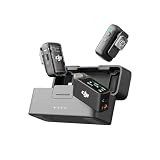
- Best premium — DJI Mic 3: the current-generation DJI system, broadcast-quality with onboard backup recording for shooters who want the latest. Premium-tier.
- Best for hybrid creators — RØDE Wireless GO (Gen 3): brings 32-bit float onboard backup (32 GB per transmitter) at a GO-class price, a strong value for camera-and-phone workflows.
- Best all-in-one kit — DJI Mic 2: clean audio and hassle-free pairing in a complete creator kit, the reliable default if you do not need the newest model.
- Best budget / phone-first — DJI Mic Mini: ultra-portable with zero-cable deploys, ideal for phone-first recording on a tight budget.
If you want pro-grade accessories, the RØDE Wireless PRO (around the pro tier) and the Sennheiser Profile Wireless (around the pro tier) are also worth a look — the Sennheiser's charging bar cleverly doubles as a handheld adapter.
Audio is one piece of the rig. To pair your mic with a body, lens, and the rest, build a complete setup and see how the parts fit together.
What changed in 2026
Onboard 32-bit float recording, once a premium feature, has trickled down into mainstream kits, so the safety-track advantage that used to justify a big price jump is now table stakes at the mid tier. Dual-channel receivers that handle a two-person interview on one system are increasingly the default rather than a step up. The practical effect: the floor has risen, and a well-specced kit like the DJI Mic 2 now covers phone, camera, and interview duty that used to need two purchases. If a kit still lacks onboard recording in 2026, that is a reason to skip it, not a way to save money.
Mistakes beginners make
- Buying for the camera you have today instead of checking the connection type, then discovering the kit ships 3.5mm TRS when your phone or newer body needs USB-C or Lightning.
- Treating the advertised line-of-sight range as real-world range, when walls, bodies, and crowds cut it dramatically.
- Skipping a kit with onboard 32-bit float recording to save money, then losing a take to a dropout or a misset level with no backup.
- Buying a single-channel system and being stuck when a second person joins the shot, forcing a whole new purchase.
- Forgetting to factor in batteries, the charging case, and windscreens, so the rig is dead or wind-blasted the moment it matters.
How much to spend
Minimum viable
The cheapest honest option is a single-channel kit that connects to your one camera or phone and at least records a local safety track. Spend here only if you shoot solo, in quiet rooms, and never hand a clip to a paying client.
Sweet spot
This is where most creators should land: a dual-channel kit with onboard recording and TRS, USB-C, and Lightning outputs, so one system follows you across every body and phone you own. The DJI Mic 2 sits squarely here and covers solo and two-person work without a second purchase.
Buy once, cry once
Pay up only if you shoot dialogue for money: more channels, deeper range, and rock-solid 32-bit float backups across the board. The philosophy is paying once for a system you will not have to replace when the job gets bigger.
How to choose: the decision that matters
Two axes really drive this purchase: connection fit (does it natively reach your camera, your phone, or both) and recovery (does it record an onboard safety track when the wireless drops). Call it the Fit-and-Recovery grid.
- Fits your gear and records safety tracks: the buy-it zone — covers today's shoot and tomorrow's emergency.
- Fits your gear but no safety track: fine for casual, quiet, unpaid work; risky the moment money is involved.
- Records safety tracks but wrong connection: great audio you will fight to get into your camera; only worth it with the right adapter.
- Wrong connection and no safety track: the trap quadrant — looks like a deal, costs you takes and adapters later.
How we researched this
Every pick is drawn from our sourced product catalog, where each spec is either sourced or flagged so you can see where a number came from. This is a research-based guide, not a hands-on lab test; read our methodology for the full approach, and check the field-level sources on each product page before you buy.