Arturia MiniFreak vs Korg minilogue XD: which to buy
Both of these are hybrid synths built on the same physical footprint — 37 slim-style keys, enthusiast-tier pricing, and a design that marries digital oscillators with analog character. That's why they land on the same shortlist. But under the hood they pull in opposite directions: the Arturia MiniFreak is a digital-first instrument with an analog filter, while the Korg minilogue XD is an analog-first instrument with a digital engine bolted on. The real decision is which half of "hybrid" you want to be the foundation.
The core trade-off is voice count versus analog authenticity. The MiniFreak gives you 6 voices driven by two stackable digital oscillator engines — wavetable, FM, granular, and more — feeding into a genuine analog filter, plus a deep modulation matrix and per-voice effects. The minilogue XD runs 4 voices, but those voices start with true analog VCOs and a real analog signal path; the digital multi-engine is a third oscillator you layer on top rather than the source itself. So you're choosing between more polyphony and a broader digital palette, or fewer voices with an unmistakably analog backbone.
Pick the Arturia MiniFreak if you want range and modulation depth more than analog purity. The dual digital engines cover sounds the minilogue XD simply can't make — granular textures, complex FM, evolving wavetables — and the 6-voice count plus a generous mod matrix make it the better instrument for layered pads, generative patches, and sound design that moves on its own. If you came for versatility and want one synth that does the most different things, this is it, and it happens to be the lower-priced of the two.
Pick the Korg minilogue XD if the analog signal path is the point. Its 4 true-analog voices deliver the warmth, drift, and saturation that define classic subtractive synthesis, and the workflow is famously immediate — one knob per function, fast to dial in fat basses, leads, and chords. The digital multi-engine adds noise, FM, and user oscillators without diluting the analog core. For players who want that hands-on, warm-sounding instrument and don't need exotic digital timbres, it earns its slight premium.
The trap to avoid: buying the minilogue XD expecting it to be a deep modulation and sound-design powerhouse, or buying the MiniFreak expecting a pure analog tone. The minilogue XD's strength is its analog character and immediacy, not the breadth of its digital section; the MiniFreak's strength is its digital range and modulation, not analog purity — its filter is analog, but the oscillators are not. Match the synth to the sound you actually chase, not to the "hybrid" label both of them wear.
One caveat that applies to both: these share the same 37-key slim-style keyboard, so neither is the right pick if full-size keys and expressive piano-style playing matter to you. Plan on a separate controller for serious keyboard work regardless of which engine you choose.
Bottom line: the Arturia MiniFreak is the more versatile, more modular, higher-polyphony instrument and the better value for sound designers and texture chasers — 6 voices and two digital engines cover a lot of ground. The Korg minilogue XD is the choice when you want a genuine 4-voice analog core with the warmth and immediacy that comes with it. Want maximum range and modulation, go MiniFreak; want true analog tone and a fast, tactile workflow, go minilogue XD.
Spec comparison (generated live)
| Spec |  Arturia MiniFreak Arturia MiniFreakArturia | 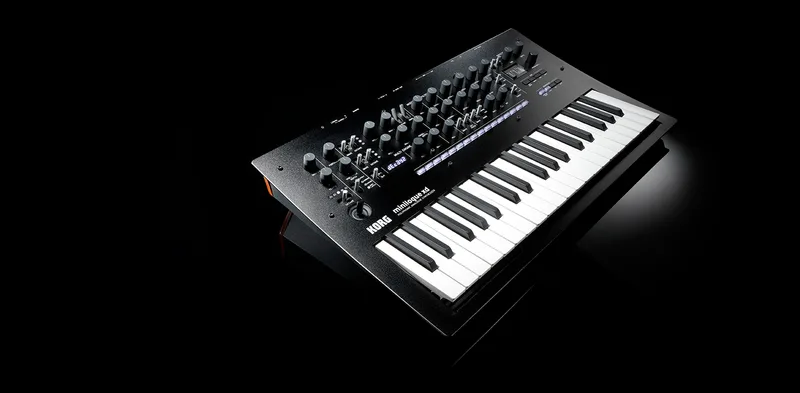 Korg minilogue XD Korg minilogue XDKorg |
|---|---|---|
| Price (tracked / list) | $599 / $649 list | $629 / $700 list |
| Overall scoreeffectively tied (within ±6pt band) | 72±3 | 69±6 |
| Tier | enthusiast | enthusiast |
| synthesis | hybrid | hybrid |
| voices | 6 | 4 |
| keys | 37 | 37 |
| Where to buy | Check price | Check price |
Some links may be affiliate links — same price for you; our comparisons are never influenced by commissions.