ADAM Audio A4V vs Eve Audio SC205: which to buy
Both of these are pro-tier German nearfields built around a folded-ribbon tweeter, sold per speaker, and aimed at the same person: someone outgrowing budget cones who wants real high-frequency detail on a desk. The honest answer is that the deciding factor is woofer size versus tweeter pedigree and DSP — the A4V brings ADAM's X-ART tweeter and networked room tuning on a smaller 4" woofer, while the SC205 trades a slightly less storied tweeter for a full 5" SilverCone driver and front-panel DSP, usually at a lower per-speaker price.
Pick the ADAM Audio A4V if you want the more flexible, more future-proof speaker and you're willing to pay for it. The X-ART tweeter is ADAM's signature — an accelerating-ribbon design that reaches well beyond the audible band and gives the A4V that airy, ultra-detailed top end the brand is known for. Just as important, the A4V is part of ADAM's networkable A Series: you tune it through the A Control software, the tweeter waveguide rotates so you can run the cabinets horizontally, and you can daisy-chain and manage a whole monitoring setup digitally. On paper it's the more accurate, more configurable tool — the catch is the 4" woofer, which is the smallest in this matchup and the one that most needs a subwoofer to feel complete in the low end.
Pick the Eve Audio SC205 if you care more about having a genuine 5" woofer under you and you'd rather not pay the ADAM premium. The SC205 typically undercuts the A4V per speaker, and that extra inch of cone (a 5" SilverCone versus the A4V's 4") gives it more low-end weight and headroom before you start reaching for a sub — its rated low corner sits around 53Hz. Eve's AMT RS1 ribbon tweeter is no slouch either; this is still a detailed, ribbon-topped monitor, not a step down to dome tweeters. Tuning lives on a front-panel knob with stored presets rather than a networked app, which many owners actually prefer for a two-speaker desk setup because it's instant and physical — no software, no Ethernet, just turn and listen.
The trap to avoid: judging these two on the spec sheet's frequency number and assuming "bigger is better" makes the choice for you. Neither a 4" nor a 5" nearfield is a low-end reference on its own — at this driver size, both of these speakers will mislead you below roughly 50Hz, and serious low-frequency work means adding a matching subwoofer to either one. So don't pay the A4V premium expecting it to out-bass the SC205 (it won't — it has the smaller woofer), and don't buy the SC205 thinking 5 inches gets you out of needing a sub for bass-heavy genres. The real differentiators are the tweeter character, the tuning workflow, and whether you'll ever want a networked, expandable monitoring system.
So who should buy which? If you're building an ADAM-centric room, plan to add a sub anyway, and value the X-ART top end plus software-driven, daisy-chainable control — especially if you might run the speakers horizontally on a console — the A4V is the more capable long-term pick and worth its premium. If you're a desk-based producer who wants the most usable, sub-free low end you can get in a compact ribbon monitor and a simpler, knob-driven setup at a lower price per speaker, the SC205 is the smarter value and the easier speaker to live with day to day. Both are legitimately pro-tier — there's no wrong answer here, only the right answer for your room, your low-end needs, and whether you'd rather turn a knob or open an app.
Spec comparison (generated live)
| Spec |  Eve Audio SC205 (single speaker - buy two) Eve Audio SC205 (single speaker - buy two)Eve Audio | 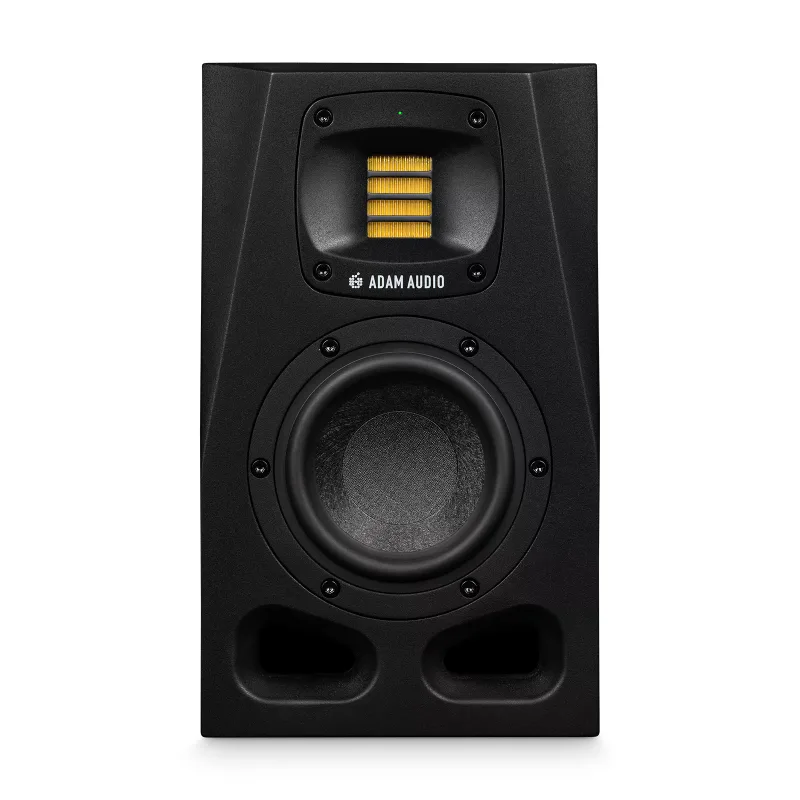 ADAM Audio A4V (single speaker - buy two) ADAM Audio A4V (single speaker - buy two)ADAM Audio |
|---|---|---|
| Price (tracked / list) | $499 | $600 |
| Overall scoreeffectively tied (within ±6pt band) | 75±6 | 79±3 |
| Tier | pro | pro |
| woofer (in) | 5 | 4 |
| powered | yes | yes |
| sold as | single | single |
| Where to buy | Check price | Check price |
Some links may be affiliate links — same price for you; our comparisons are never influenced by commissions.